Sleeping gear - what really works on the Green Belt?
When we analyze two years of data from 88 hikers who together walked 114,400 kilometers through the Scandinavian mountain range, a clear pattern emerges:
It's no longer about individual gadgets.
It's about systems.
Temperature - where most people land
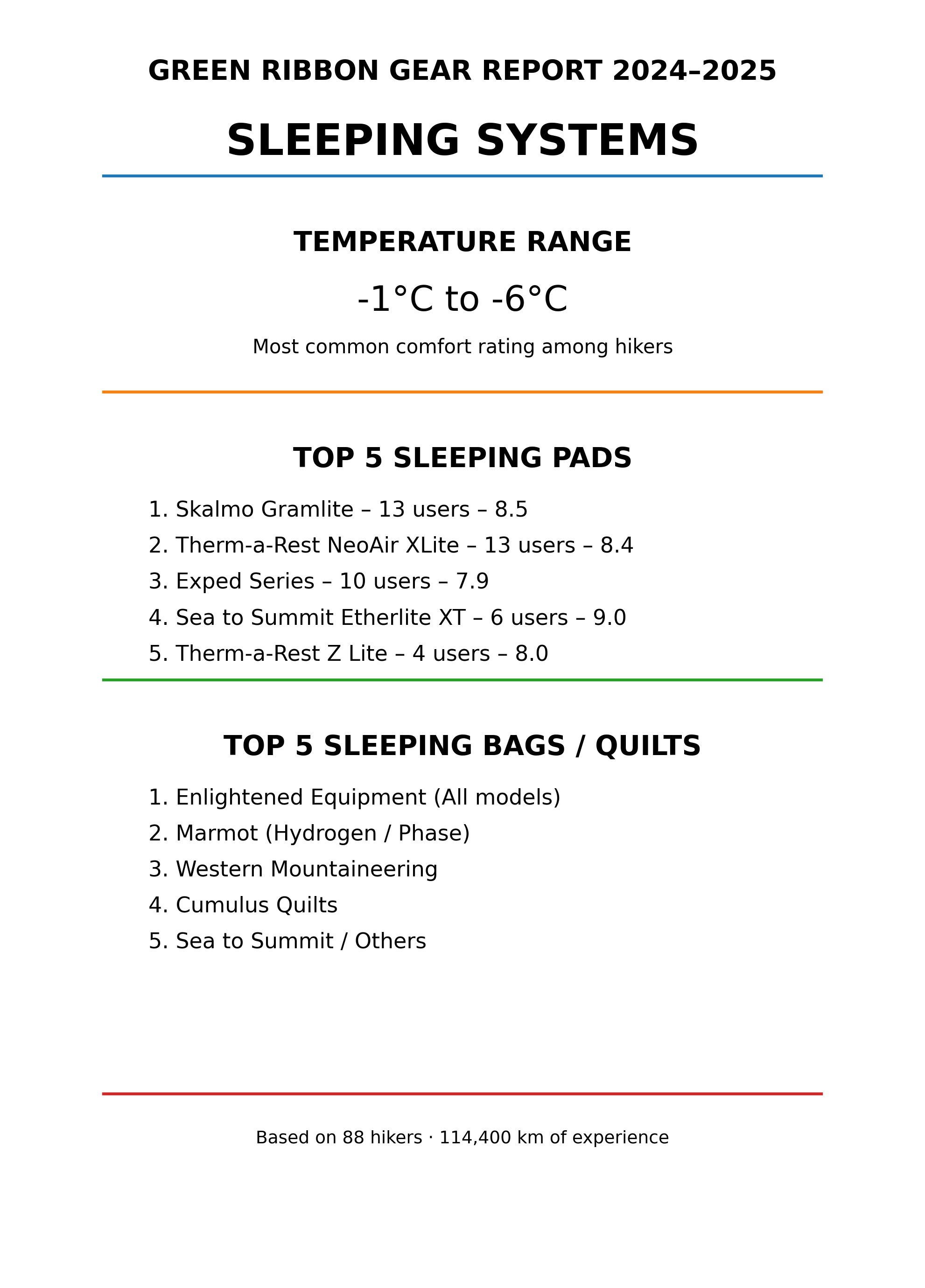
Whether you choose a sleeping bag or a quilt, most people end up in the same range:
-1°C to -6°C.
This provides:
-
Enough warmth for normal summer nights
-
Safety margin for colder periods
-
Flexibility with clothing
It's not extremely light.
But it is light enough - and safe enough.
Sleeping pads - the foundation of the system
One of the most important insights:
Ground insulation is at least as important as the sleeping bag
Most hikers land around:
R-value 4-5
But the most interesting thing isn't which base layer is used -
but how they are combined.
Skalmo Gramlite - the unexpected favorite
The most used product in the whole data is:
Skalmo Gramlite.
But:
It is not a classic sleeping pad.
It is used as:
-
Seat pad
-
Protection under inflatable
-
Extra insulation
-
Anti-slip surface
It doesn't replace the system - it enhances it
And that makes it one of the most appreciated gadgets among Green Belt hikers. Read more or buy a Skalmo Gramlite here :
Quilt vs Sleeping bag - two clear tracks
Quilt
-
Lighter
-
More flexible
-
Less packing volume
-
Common choice among the weight conscious
Sleeping bag
-
More enveloping
-
Easier to handle
-
Better in exposed conditions
Both work Both get high ratings
But:
The big change
When we put 2024 and 2025 together, we see clearly:
Enlightened Equipment is the most used sleeping system overall
-
Enigma was #1 already in 2024
-
Continues to dominate as a brand in 2025
What this means:
Quilt is no longer a niche
It's mainstream among experienced hikers
Enlightened Equipment - the favorite among quilters
When we look at the whole material, one brand is particularly clear:
And within their range, there is one model that stands out.
Enigma 20° - the most used quilt
The Enlightened Equipment Enigma 20° stands out as the clear favorite.
What sets the Enigma apart from many other quilts is the closed footbox.
This means:
-
Less heat leakage
-
Easier use in colder conditions
-
Slightly lower weight compared to open constructions
The comfort temperature is claimed to be around -1°C, although the US temperature claim is often more optimistic (around -6°C according to their own scale).
In practice, it's exactly where most Green Belt hikers want to be.
Weight and use
The weight is typically between:
600-670 grams
depending on the length and width.
This makes it a very attractive choice for:
-
Long hikes
-
Weight-conscious systems
-
Combination with lighter sleeping pads
Read more about EE Enigma here.
For those who are cold
For those who know they sleep cold, there is a clear alternative:
It provides extra margin - something that many people appreciate on cold mountain nights or on longer trips late in the season.
Revelation - just behind
Close behind the Enigma we find the Enlightened Equipment Revelation.
The main difference is the construction:
-
Openable footbox
-
More flexible use
-
Can be used as a duvet in warmer conditions
This makes the Revelation a more versatile option -
but also slightly less effective in colder temperatures compared to Enigma.
What does this mean?
The fact that Enlightened Equipment dominates the statistics is no coincidence.
It reflects a larger movement:
-
A focus on lightweight
-
Modular systems
-
Sufficient - not maximum - heat
And in that context, Enigma hits the mark.
Three clear trends
1. the quilt system is growing
More people are moving towards lighter, modular solutions.
2. systems thinking dominates
Common setup:
-
Quilt or sleeping bag (-1 to -6°C)
-
R-value 4-5
-
foam (Gramlite)
3. New influences
We're also seeing new brands and players starting to make their way into gear choices.
Products from smaller, more niche brands are increasingly appearing in packing lists - especially in the quilting segment.
Gramjakt
Gramjakt has developed a quilt specifically for Swedish mountain conditions, with a comfort temperature of around -6°C - right in the range where most hikers land.
What makes it extra interesting is the combination of:
-
Thoughtful design for Nordic conditions
-
Low weight
-
More accessible pricing
By selling directly to the customer, with fewer middlemen, Gramjakt can offer a more attractive price compared to many traditional premium quilts - without compromising on quality. See Gramjakt's quilts here :
Vilse
Vilse represents a different track - more craft-driven.
Their quilts are made on a smaller scale, with production in Sweden and Poland, and have gained a good reputation for:
-
High quality
-
Low weight
-
Thoughtful construction
These are products that often appeal to the more discerning user - where feel, level of detail and choice of materials play a big part. See Quilts from Vilse here
What does this mean?
This points to a clear trend:
-
More options in the quilt segment
-
Greater price diversity
-
Increased availability of products adapted to Nordic conditions
The result:
-
Lower base weight
-
More quilts in use
-
More sophisticated and individualized systems
It's not just a technological development - it's
it's a broadening of the market.
Sleeping pads - the next clear shift
If the quilt trend is all about the top of the sleeping system, we are now seeing a similar shift from below.
Sleeping pad choices are becoming more conscious - and more diversified.
Therm-a-Rest NeoAir XLite - the reference point
Therm-a-Rest NeoAir XLite is the most widely used inflatable sleeping pad in the material.
And that's not particularly surprising.
XLite has been something of a standard in lightweight hiking for many years:
-
Low weight
-
Sufficiently high R-value
-
Compact pack volume
-
Proven construction
It's a safe choice.
A sleeping pad that many people trust - and that works in most situations along the Green Belt.
But it's also just that:
A reference point rather than a cutting-edge choice. Read more about Xlite here
Sea to Summit & Exped - established options
Sea to Summit Etherlite XT and Exped (Synmat/Ultra series) are two other well-known options.
They often offer:
-
High comfort
-
Stable construction
-
Good insulation
The Etherlite in particular stands out for its thickness and comfort - a popular choice for those who prioritize sleep quality.
But in the data, we see that these options:
- Not growing at the same rate
- And in some cases are losing ground to relatively new entrants offering the same comfort but with higher warmth such as Big Agnus Rapide or Gramjakt UL R&
That doesn't mean they are inferior.
But the market is moving.
The shift we are starting to see
The most interesting thing is what is happening now.
We can clearly see how new players are starting to emerge - and how choices are becoming more informed.
Gram Hunt UL R6
In the same spirit as their quilt, Gramjakt has developed a sleeping pad adapted for Nordic conditions.
UL R6 places itself in the middle of the range where most hikers land:
-
Low weight
-
High R-value
-
Adapted for mountain conditions
Just like the quilt, it is based on the same idea:
Great performance at a more accessible price
Thanks to a more direct business model, it can compete with established premium options - but at a lower cost. Read more about Gramjakt UL R6 here
Nemo - for those who prioritize weight
Nemo continues to be the obvious choice for those chasing grams.
Models like:
attract hikers who want:
-
Minimal pack weight
-
Compact pack volume
-
Sufficient comfort within R 4-5
This is the choice for those who prioritize the lightest possible system - without completely compromising on function.
Big Agnes Rapide SL - comfort on the rise
At the same time, we see a clear counter-movement.
Not everyone wants to optimize to every gram.
Big Agnes Rapide SL is a clear example of a product that is growing in popularity:
-
Thicker construction
-
Softer feel
-
Higher sleeping comfort
It is particularly appreciated by:
- Side sleepers
- Those who want more "bed feeling" in the tent
What does it mean?
We now see three clear directions in sleeping pads:
-
Optimization (Nemo) → lowest possible weight
-
Balance (Gramjakt) → weight + warmth + price
-
Comfort (Big Agnes) → better sleep, slightly higher weight
Conclusion
As with the sleeping system as a whole, there is no longer one right answer.
But there is a clear pattern:
- Walkers choose more consciously
- More adapting to their own sleeping style
- Systems thinking is becoming more important
And that's where the evolution is happening.