
Backpackinglight · Guide
Common packing mistakes – what experienced hikers leave at home
The simplest way to save weight requires no new purchases. It means no longer carrying things you never use.
In our earlier compilations of Gröna Bandet hikers’ experiences, we asked what they would leave at home if they did the hike again. Here we keep the practical lessons and add verified examples and results from the 2026 survey dataset – without mixing the surveys together.
An extra jumper. An extra power bank. An extra pot. A poncho “just in case”. Each item seems small. Together they add weight, bulk and the need for a bigger backpack than you really need.
This guide explores recurring mistakes, why they happen and how to avoid them.
The essentials to understand
- Many hikers pack too many clothes.
- Duplicated functions create unnecessary weight.
- Stoves, fuel and electronics can easily weigh more than expected.
- Safety margins need to reflect the actual risks of your trip.
- The lightest equipment is what you leave at home.
1. Clothing: more garments than the trip needs
The earlier material mentions clothing among the unnecessary equipment: extra trousers, extra jumpers, extra base layers, extra socks and garments that never leave their stuff sack.
It is easy to understand why. Clothes feel reassuring to pack. One extra jumper does not weigh much. But three extra garments can quickly add half a kilo, and the space they take affects your whole pack.
The aim is not to get cold or take chances. It is to build a clothing system in which every garment has a clear purpose.
A useful question: What weather or situation does this garment cover that no other garment already covers?
If you cannot give a clear answer, the garment is often a candidate to leave at home.
2. Duplicated functions easily become dead weight
Several hikers describe items that solved the same problem twice. These might be extra lights, extra cooking accessories, extra tools, extra rain protection or several small “handy to have” items that never get used.
The principle is simple: every important function should be covered in your pack, but it does not always need to be covered twice.
If your multitool already has a knife, you may not need a separate knife. If your rain jacket provides your rain protection, a poncho needs a clear purpose of its own. Backup power and lighting, however, need to be assessed against the season, route section, navigation and what you need if the trip takes longer than planned.
This is not minimalism. It is knowing your pack. You should know why every item is in your backpack.
3. Stoves and fuel: easy to take too much
Cooking systems are a category in which many hikers are satisfied with their setup, yet unnecessary items still appear in the responses: an extra pot, a backup stove, too much fuel or a setup that exceeded the trip’s needs.
For many hikers a simple system is enough: a burner, a lightweight pot and fuel suited to the route section.
The important thing is to think of cooking equipment as a complete system. Burner, pot, lid, wind protection, ignition and fuel belong together. A light burner helps less if you also carry too much fuel or several unused cooking accessories.
A useful question: How many times will I actually cook before I can resupply?
The answer helps you plan your cooking system and fuel. Test your consumption and allow a considered margin for cold, wind and delays.
4. Electronics weigh more together
Electronics often feel light individually: a power bank, a headlamp, a camera, a charging cable, a spare battery.
Together, however, they can become a significant weight category. The earlier compilation mentions extra power banks, headlamps and batteries as items some hikers could have left at home or reduced.
On summer hikes in the mountains, daylight also lasts a long time. That does not mean a headlamp is always unnecessary, but it does mean you should consider how much you will actually use it.
Useful questions:
- What must I be able to charge?
- How often will I have access to electricity?
- How much hiking will I actually do in the dark?
- Do I need a backup, or would a smaller setup be enough?
Electronics should provide safety and functionality. They should not come along out of habit.
5. “Just in case” needs to become specific
The hardest things to leave at home are often those packed out of worry: extra clothes in case it gets cold, extra food if a section takes longer, extra gear if something breaks.
Some margin is sensible. But it should be thought through, not unlimited.
Experienced hikers do not pack without a margin. They make that margin more specific.
Instead of “extra clothes”, they choose a garment that covers several cold conditions. Instead of “extra food”, they calculate what the sections require and add a reasonable reserve. Instead of a large pile of spare equipment, they take what can actually solve likely problems.
The difference between an experienced hiker’s pack and a beginner’s is often not that the experienced hiker carries fewer things. It is that they know why each item is there.
New findings from the 2026 survey
The 2026 survey dataset contains 62 responses about Gröna Bandet: 35 cover the full route, 26 cover sections and one does not specify the extent. The new material provides more concrete examples of items that became unnecessary – but also of small things that earned their place.
Ten things some hikers would leave at home
The examples below come from the free-text compilation in Part 7. They are not a ranking and do not show how common these mistakes are. An item that was unnecessary for one hiker may be important for another.
- The camping chair – sent home when it was too cold to sit outside.
- Fishing equipment – two hikers mention it as unnecessary.
- The solar panel – of little use to one hiker during an overcast period; others valued theirs.
- Waterproof socks – unused or less successful for some hikers.
- Extra pairs of socks – more than were actually needed.
- Sandals as camp shoes – one pair was sent home.
- A GoPro with accessories – one hiker would rather use a better phone camera.
- The razor – had no important role on that trip.
- The coffee filter – became unnecessary for one hiker.
- A heavy Nalgene bottle – sent home.
Small things that stayed
The same material mentions appreciation for sports tape, repair tape and patches, a needle and thread, a small cloth, earplugs and small clothes pegs. A power bank is also mentioned as a useful companion. The lesson is not to remove all small items, but to judge their usefulness. These examples are neither a shopping list nor a ranking.
Pack weight and satisfaction – an association, not a guarantee
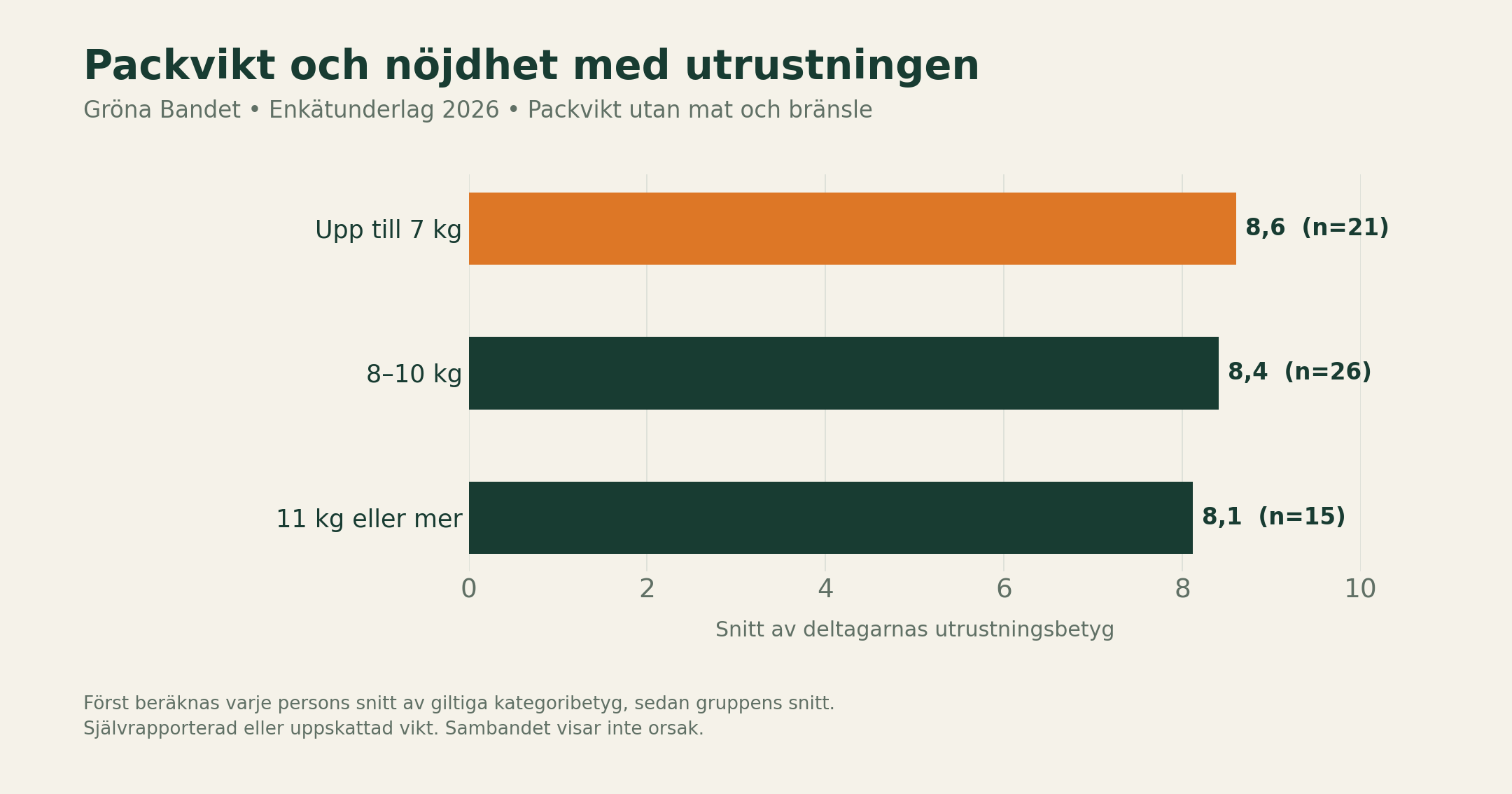
Of the 62 respondents, 21 report a pack weight of no more than seven kilos, 26 report eight to ten kilos and 15 report eleven kilos or more. Their average ratings of their equipment as a whole are 8.6, 8.4 and 8.1 respectively. These are not ratings of the backpack alone.
The question concerns the backpack and its contents without food and fuel; the weight may be estimated. This measure should not automatically be called base weight, because the survey definition does not explicitly exclude water. Lower weight may be associated with satisfaction in this group, but the material does not show that reducing weight causes higher ratings.
A practical next step is to pack for your longest section between food resupplies, walk with the backpack and check what each item actually contributes. Keep weather protection, warmth, navigation, the means to handle injuries and enough food and energy for the conditions of your trip.
How to avoid the mistakes
Go through your pack item by item and ask five questions:
- What function does this item serve?
- Is that function already covered in my pack?
- Have I used it on previous trips?
- What happens if I leave it at home?
- Can the problem be solved in a lighter way?
Then weigh everything. Not approximately, but on a kitchen scale. Write down the weights.
When you see that a few extra garments, cables and small accessories weigh more than your cooking system, decisions become easier. Packing lighter stops being a feeling and becomes something you can see.
The aim is not to pack as little as possible. It is to know why each item is there and have the confidence to leave the rest at home.
About the material
The guide retains the practical foundation of the earlier article. The new examples and figures come from the published compilations in Parts 1, 2 and 7 of the 2026 survey dataset. The year refers to the dataset, not a verified hiking year for every response. The free-text lists are selected examples, not complete rankings or frequency measurements. The sample does not represent all Gröna Bandet hikers. Earlier references to 88 hikers or pooled responses from several years are not counted as this year’s 62 responses. Backpackinglight runs the survey and also sells equipment.
Read more: the survey and rankings
Next steps for your own pack
- Packing lists for the White and Green Ribbon
- Explore long-distance hikers’ packing lists on GearGarage
- Lightweight hiking packing list – PDF and checklist
- How to pack your backpack
- The big three under 3 kg
- Food planning for mountain hiking
- Lightweight hiking – the complete guide
- Equipment on Gröna Bandet – the full article series
- All Guides