
Backpackinglight · Gröna Bandet
What worked on Gröna Bandet? The bigger picture and the key lessons.
A gear list tells you what came along. The experiences afterwards tell you what was actually appreciated. In the first part of our Gröna Bandet series we look at the bigger picture: what participants were happy with, where the dissatisfaction was, and which lessons can help you before your next trip.
The bigger picture and the key lessons
The 2026 survey material contains 62 responses about Gröna Bandet. Of these, 35 cover the whole trail and 26 cover sections of it. One response has no information about distance. This gives us experiences from different kinds of trips, but also reasons to be cautious about far-reaching conclusions.
We begin with three questions: which gear category received the highest rating? Which received the lowest? And did those who carried a lighter pack also rate their gear higher?
Overall, hikers are happy with their gear
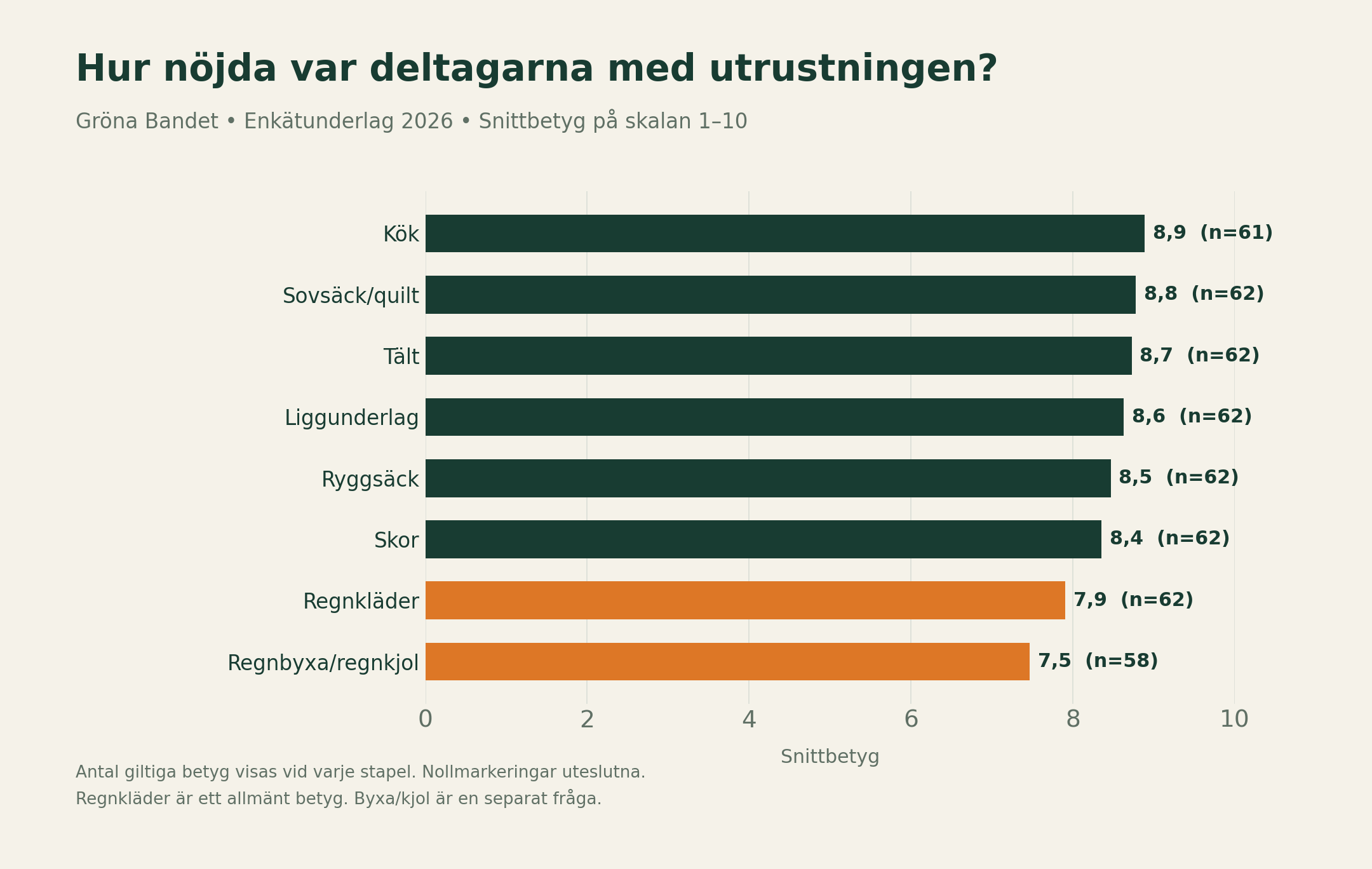
The cooking solution receives the highest average rating, 8.9 out of 10. Sleeping bags and quilts sit at 8.8, followed by tents at 8.7 and sleeping pads at 8.6. Backpacks and shoes also average above eight.
That is an encouraging picture if you are planning your hike. Among those who responded there is a lot of gear they have been happy with. At the same time, an average can hide both very good and much worse experiences. That is why, in the following parts, we will show the number of responses together with the models’ ratings.
Rain gear has the greatest room for improvement
Rain clothing in general averages 7.9. The separate question about rain trousers and rain skirts has the lowest average of the gear categories: 7.5.
Dissatisfaction is also more visible here. Twelve of the 58 valid ratings for rain trousers and rain skirts fall between one and five. In the question about rain clothing in general, the corresponding figure is ten of 62.
This means rain protection deserves extra attention in the planning. In the rain part of the series we look closer at different ways of dressing and what participants describe as working or problematic. The general rain rating covers the entire rain solution and should not be read as a separate test rating for a particular jacket.
A lighter pack goes together with a slightly higher rating
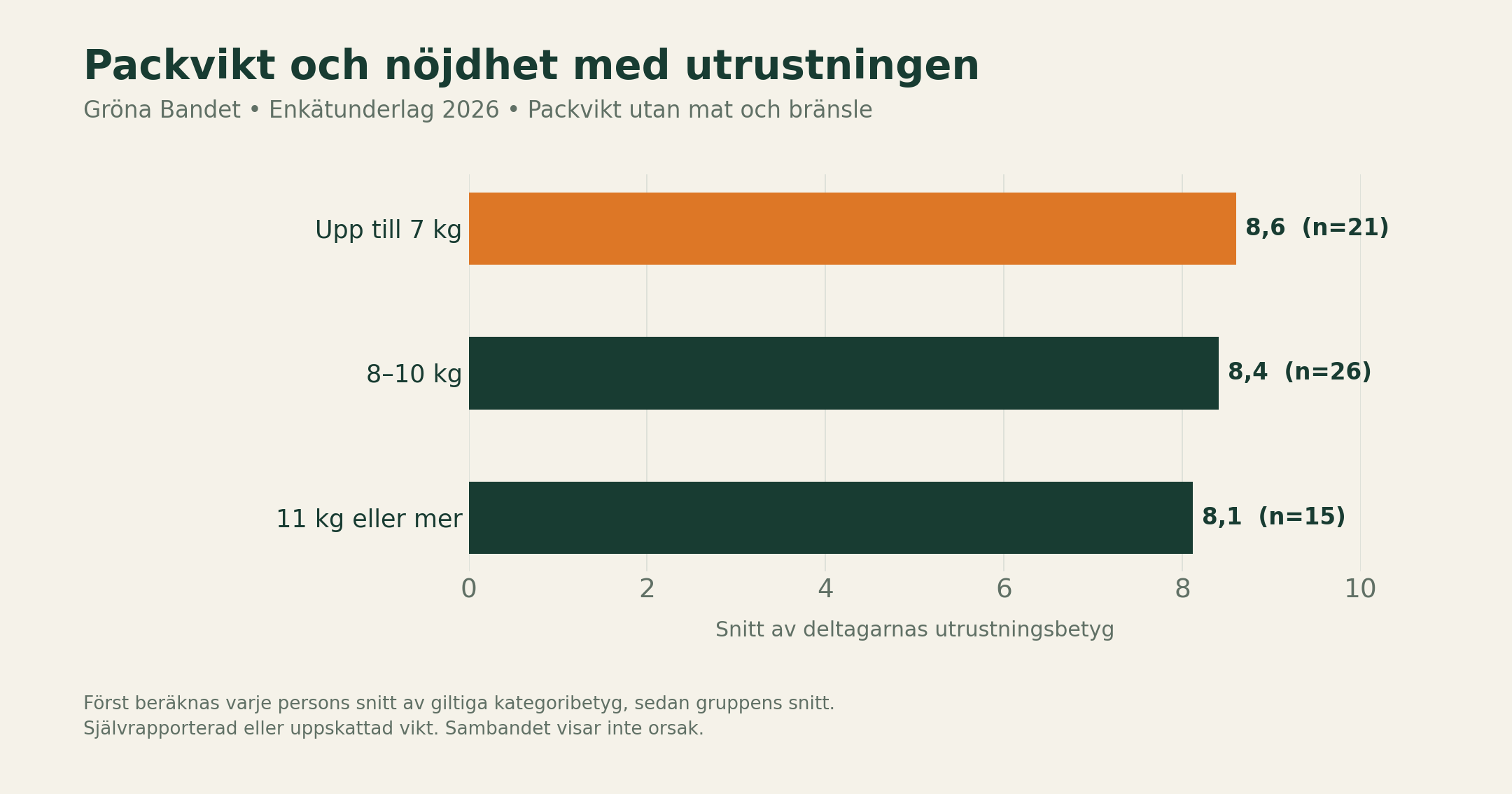
The 21 respondents who report a pack weight of up to seven kilos give their gear an average rating of 8.6. The group of eight to ten kilos, 26 responses, sits at 8.4. The 15 who report eleven kilos or more sit at 8.1.
The weight in the question refers to the backpack with its contents, without food and fuel, and may be an estimate.
We cannot say that lower weight causes greater satisfaction. Experience, gear choices and the conditions of the trip can also play a part. One practical lesson is to examine what each item adds and to test the whole pack together before departure.
40–60 litres is the most common backpack choice
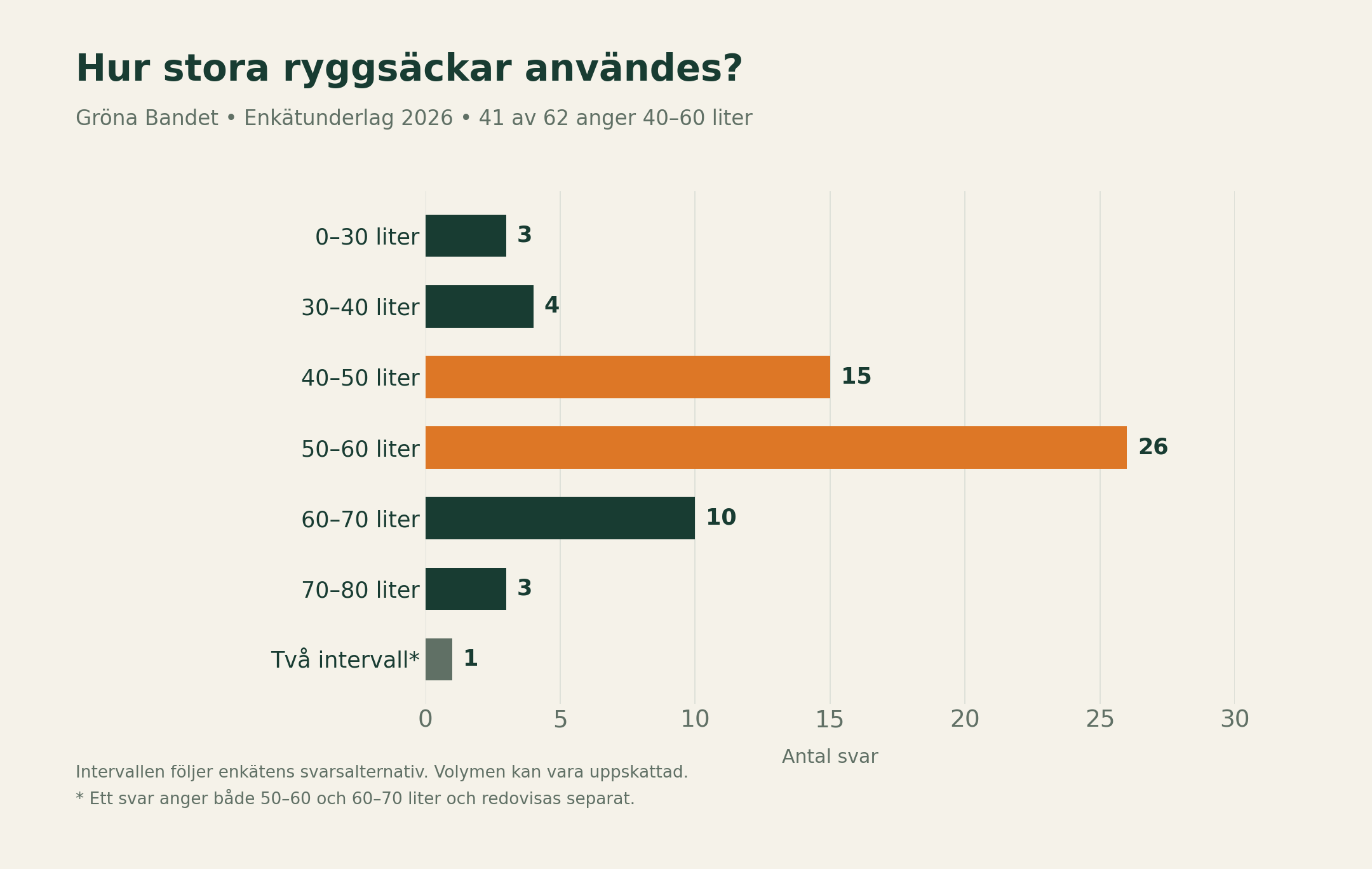
41 of 62 respondents report a backpack in either the 40–50 or the 50–60 litre interval. That corresponds to roughly two thirds of the group. The single most common interval is 50–60 litres, with 26 responses.
This says something about the participants’ choices, but is not a ready-made size recommendation. How much space you need depends, among other things, on the packed volume of your gear and how much food has to fit between resupplies. So test-pack with the amount of food you actually need to carry.
Small items also have a place in the story
In the free-text answers, sports tape, repair patches, a small cloth, ear plugs and small clothes pegs are mentioned, among other things, as appreciated details. These are examples from the participants, not a ranked list.
Before your own hike, the experiences can become three questions for your packing list: have I tested my rain solution? Does what I carry add enough? And does the pack work as a whole when the food has to come along too?
In the next part we look more closely at the backpacks: which brands and models the participants used, what ratings they received, and how you can use the experiences when making your own choice.
About the material
The article is based on the Gröna Bandet answers in the 2026 survey material. The year refers to the material and is not a verified year of hiking for every response. The ratings are self-reported on a scale of 1–10, and zero ratings have been excluded. Each question covers 62 valid ratings, except the cooking solution with 61 and rain trousers/rain skirts with 58. The pack weight comparison first takes each person’s average of their available gear ratings and then the group’s average. The sample is not a representative selection of everyone who has hiked Gröna Bandet. Combined statistics from several years are reported separately in the series’ rankings.
Gröna Bandet 2026: What worked all the way?
- 01What worked on Gröna Bandet? The bigger picture and the key lessons.
- 02The backpack and pack weight.
- 03The tents that came along.
- 04A good night’s sleep: sleeping bags, quilts and sleeping pads.
- 05Rain puts gear to the test.
- 06The shoes that carried hikers all the way.
- 07The stove and the small details.
2026 gear rankings
Explore all packing lists and create your own
Guides
Practical guides for planning, packing and life on the trail.